
Arrest History in Los Alamos County
Most local arrest records begin with the Los Alamos Police Department. LAPD creates incident and arrest reports, handles local warrants, and operates the Los Alamos County Detention Center. New Mexico State Police may hold the originating report for a state-police arrest. National Park Service rangers can be the correct custodian for an incident at Bandelier National Monument, while federal agencies may retain reports tied to federal land or authority. The badge named on the arrest or court record therefore matters more than a broad request sent to every office.
An arrest history is a chain, not one file. The arresting officer records the alleged offense and legal basis for custody. Detention staff then create a booking file. A prosecutor decides which charge, if any, enters Municipal, Magistrate, District, or federal court. Fingerprints from covered New Mexico arrests can also reach the New Mexico Department of Public Safety Law Enforcement Records Bureau. Each part can change at a different time, and the final court disposition may be quite different from the first allegation.
Four Los Alamos Arrest Custodians
A Los Alamos County arrest can touch four custodians. The arresting agency owns its report. LAPD detention owns the local intake and release record even when another agency delivers the person. New Mexico courts own the prosecution docket, bond order, warrant events, and outcome. NMDPS LERB holds the subject-only, fingerprint-founded statewide arrest record. Asking one office for all four layers usually produces an incomplete answer.
LAPD Records is the practical first stop for an identified local incident. Its division collects, approves, files, safeguards, and retrieves crime, accident, citation, warrant, booking-related, and arrest documents. The formal county fallback is Records and Information Management, or RIM, for an Inspection of Public Records Act request. A narrow request should name the desired object, such as a chronological blotter entry, CAD event, arrest report, booking sheet, or release record. Include the date range, location, event or case number when known, and preferred electronic format.
LAPD Records Division
2500 Trinity Drive
Los Alamos, NM 87544
505-662-8225
Use for identified police, arrest, citation, warrant, and booking-related records.
How to Look Up Los Alamos County Arrests
No verified Los Alamos County jail roster or public booking-log interface was found in official sources. That makes the fallback chain the main method, not a second choice. Begin with present custody, identify the arresting agency, request the proper local record, and then follow the matter into court or another correctional system. Use a full legal name and an approximate arrest date, but do not treat a name match as proof of identity.
- Call LAPD non-emergency or detention at 505-662-8222 for present local custody. Give the full name and approximate arrest date, and never use 911 for a records question.
- Ask LAPD Records at 505-662-8225 for the chronological blotter, arrest report, or booking sheet. If a different agency made the arrest, request its originating report instead.
- Search New Mexico Case Lookup and contact the correct Los Alamos court clerk. Court data may show the filed charge, bond, hearings, warrant events, and disposition even before a records request is filled.
- Submit a written IPRA request through LAPD Records or county RIM when the direct inquiry is not enough. Ask for segregable public portions if a report includes protected material.
- For your own statewide history, send the notarized DPS Authorization for Release of Information to LERB. New Mexico has no unrestricted public name-search portal for this record.
- After a transfer, use NMCD Offender Search for state prison or supervision, or the federal BOP locator for federal custody. Neither is a local booking roster.
Note: A search absence never proves that an arrest, transfer, or case does not exist; verify with the office that created the record.
No Los Alamos Arrest Roster
The lack of a public roster is a key feature of Los Alamos County arrest access. LAPD’s jail-management system is not a public database, and no official booking-photo gallery was confirmed. Current custody calls may answer a narrow status question, but a booking sheet or blotter request is the better route for a stable record. The county detention page can confirm the facility and contact channel without acting as a searchable list.
A roster, if one existed, would still show only a slice of time. Release, transfer, and data-update practices can make a person vanish from current-custody results while the arrest report, court docket, and repository cycle remain. For that reason, follow a recent arrest into the court record. Municipal Court covers limited local matters, Magistrate Court handles misdemeanors and felony preliminary stages, and First Judicial District Court holds felony trial files. The Los Alamos County criminal court case record is the best place to confirm what prosecutors filed and how each count ended.
What an Arrest Record Shows
An agency arrest report may contain the call or event number, officers, alleged offense, probable-cause narrative, evidence, property, vehicle, citation, and referral details. A Los Alamos County booking record adds the detention intake facts. Public versions can omit victim and witness details, confidential methods, medical or security information, juvenile material, and personal identifiers. The exact public fields depend on the requested record and any lawful redactions.
| Booking number and time | The local intake identifier and recorded date and time of admission. |
|---|---|
| Arresting agency | The agency that established custody and generally holds the originating arrest report. |
| Initial charges | The allegations or warrant basis accepted at intake, which may differ from later filed counts. |
| Bond or hold | The court-set release terms or another legal basis that prevents release. |
| Identifiers and intake | Fingerprints, photograph, property inventory, classification, and basic identifying details, subject to access limits. |
| Release status | The recorded release time and reason, or transfer to another agency or correctional authority. |
| Photograph access | No public Los Alamos County gallery was found. A specific request remains subject to IPRA, privacy, investigation, security, and expungement rules. |
The official New Mexico expungement definitions illustrate how arrest, charging, and case notations are treated as distinct records.
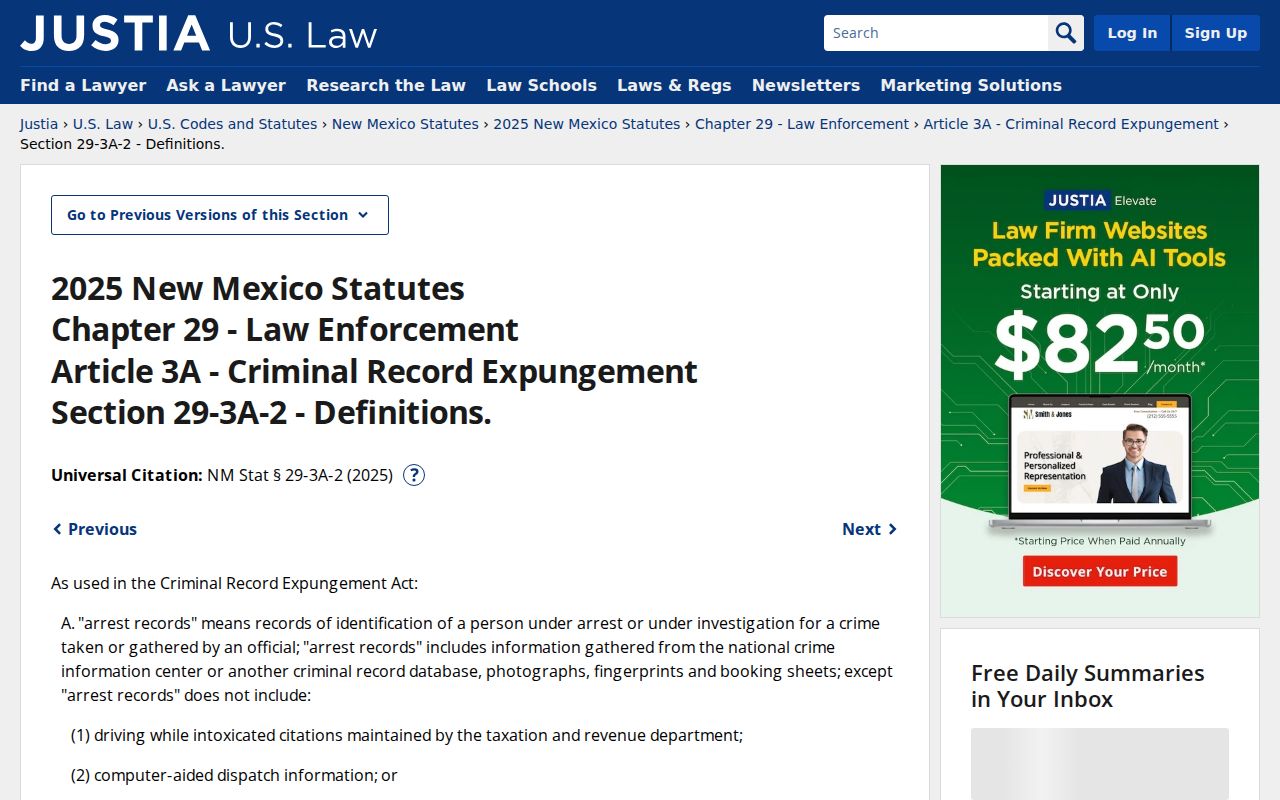
That distinction matters when a court orders qualifying records removed from general-public access across separate agency systems.
Inside a Los Alamos Booking
After an officer establishes lawful custody, the person is taken to the LAPD-operated detention center. Staff verify the arrest authority and charge, create a jail entry, inventory property, take fingerprints and a booking photograph, screen medical and mental-health needs, and classify housing. Covered fingerprints become the source document for a submission to NMDPS LERB. A judge, not detention staff, controls probable cause, counsel, bond, release conditions, and the next hearing.
The record path can be read as a sequence: call or report → arrest documentation → detention intake → repository submission → first appearance → prosecutor filing → disposition → release or transfer. A jail employee cannot change a judge’s release terms. On release, detention verifies court authority and holds, returns releasable property, and records the time and disposition. If a state prison, probation, or parole term follows, NMCD opens a separate corrections record.
Recent Arrests and Booking Logs
For a very recent Los Alamos County arrest, call detention first, then request the record. Section 29-10-7 NMSA 1978 makes chronological police blotter information available for inspection. Its public baseline includes the arrested person’s identity and description, arrest time and place, alleged offense, and arresting officer. A public-facing request can focus on the event and process without seeking a home address, full birth date, or other data that is not needed.
Ask separately for the blotter entry, arrest report, and booking sheet because those are different objects. If LAPD withholds part of a narrative, request the reasonably segregable nonexempt portion and the legal basis for the redaction. Active investigative details, confidential sources or methods, victims, juveniles, medical facts, and security information may be protected. IPRA generally calls for inspection at once or as soon as practical, with a 15-calendar-day outside response point unless a burdensome request receives written notice.
Los Alamos Booking Numbers
The county’s official public-safety procurement record describes a 32-bed detention center with separate male and female pods, court housing, visitation rooms, and temporary regional or state holds. Annual bookings fell from 376 in 2018 to 109 in 2022. Average daily population fell from 17 to 3 across the same endpoints. These figures measure facility use, not unique people or crime. One person can account for more than one admission, and pandemic-era policy or system changes can affect the count.
That context helps prevent a common error. Fewer bookings do not prove that offense reports fell by the same share, just as a high call-for-service count does not equal an arrest count. LAPD Records handles citations, warrants, supplements, subpoenas, and many other files besides bookings. Compare like with like before drawing a trend from Los Alamos County arrest data.
Los Alamos Arrest Fingerprint Flow
New Mexico uses fingerprints from covered arrests as the State Central Repository source document. Felonies, DWI, and misdemeanors punishable by at least six months are among the arrests described in the research flow. LERB then depends on police, courts, and other criminal-justice agencies to report later events. Missing prints, aliases, delayed submissions, or a disposition that has not yet reached the repository can leave an incomplete cycle.
For self-review, New Mexico does not offer the public an instant name lookup. Section 29-10-6 permits the individual, counsel, or an authorized agent to inspect arrest-record information about that individual. LERB requires a complete, legible, notarized Authorization for Release of Information. If a result is wrong or lacks a disposition, obtain proof from the court and follow the repository correction path. Correction makes an entry accurate; expungement removes qualifying material from general-public access after the statutory court process.
Arrests vs Convictions
An arrest states that an officer took a person into custody based on a warrant or probable cause. It does not decide guilt. A conviction follows a plea or finding in court and appears in the judgment and disposition. In Los Alamos County, initial booking labels may be changed, reduced, declined, dismissed, or resolved through another lawful outcome. Always read the court result for each count rather than treating the first police allegation as the last word.
| Arrest Record | Conviction Record |
|---|---|
| Created by the arresting agency and detention staff. | Created by the court after a plea or finding. |
| Shows custody and an initial allegation. | Shows a judgment of guilt on a filed count. |
| Lives in police, blotter, and booking systems, with covered fingerprints reported to LERB. | Lives in the clerk’s case file and may be reported to LERB. |
| May lead to release without charges, dismissal, acquittal, diversion, or conviction. | May lead to sentence, appeal, supervision, or qualifying expungement relief. |
Note: An arrest is not proof of guilt, and a booking charge may differ from the charge and outcome recorded by the court.